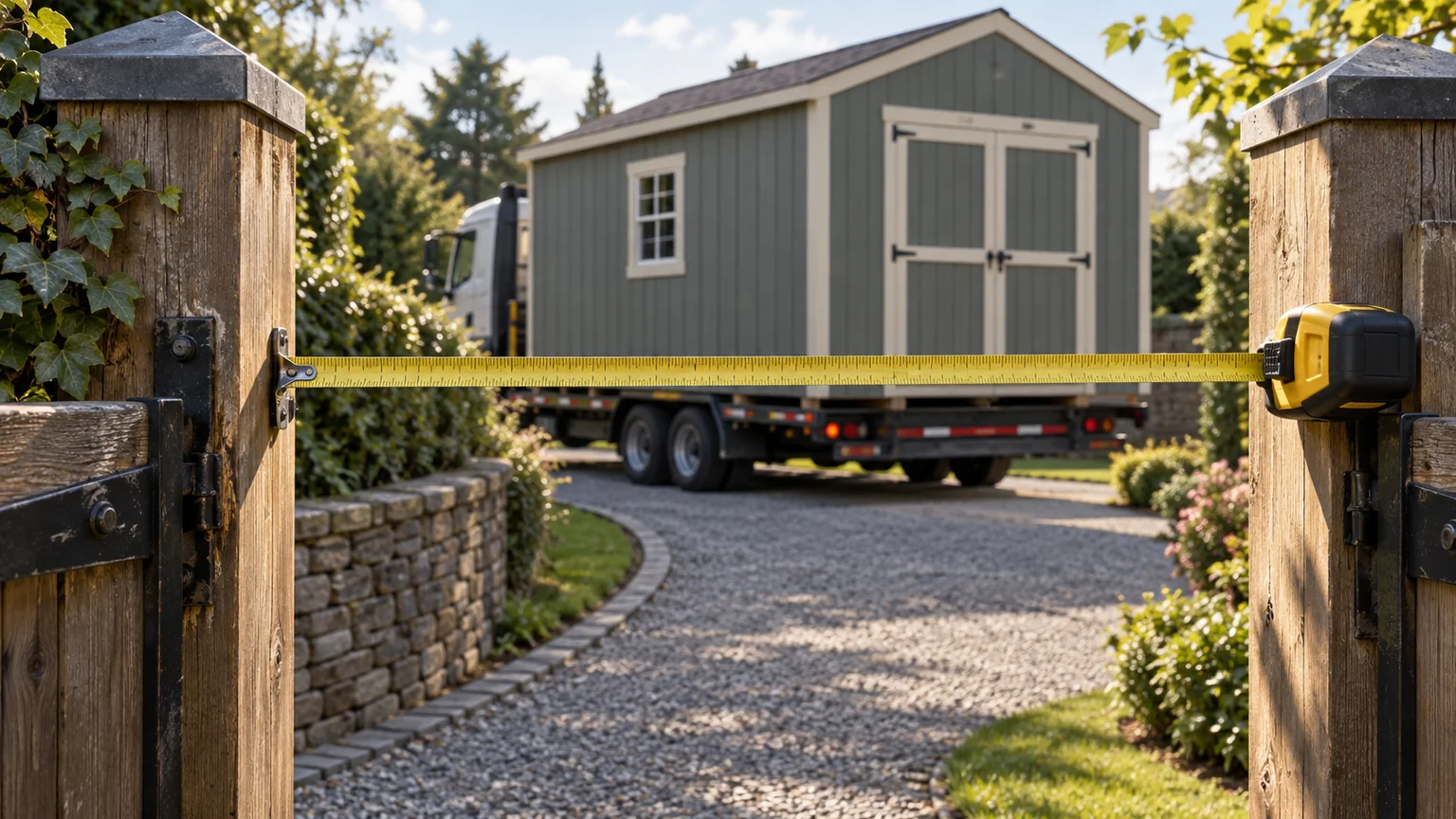
Picture a 12-foot-wide shed waiting outside a gate that measures 8 feet 10 inches. Before you account for the delivery equipment or roof overhangs, the building is already 3 feet 2 inches wider than the opening.
This is a planning example, not a report about a documented customer. Its lesson is useful precisely because the arithmetic is so ordinary. A finished building can be exactly right for the order and still have no practical route to its destination.
The solution begins before the delivery date: a shared record of the building, equipment, route, ground, and final placement, reviewed by the people responsible for moving it.
Measure the delivered object
The size in the product name may describe a floor footprint. The largest dimension during transport can be different. Roof overhangs, trim, projecting hardware, wheels, lifting equipment, and the chosen orientation all matter.
Ask the delivery team for the transport envelope and the clearance they require for this particular job. Do not substitute a universal rule such as “add two feet.” Equipment, turning geometry, slope, and operating conditions change the requirement.
Record the source of each measurement. “Customer estimate” is useful information, but it is different from a measurement checked by the delivery coordinator. Photos should show the measurement in context instead of leaving a tape floating somewhere between two fence posts.
Walk the entire route
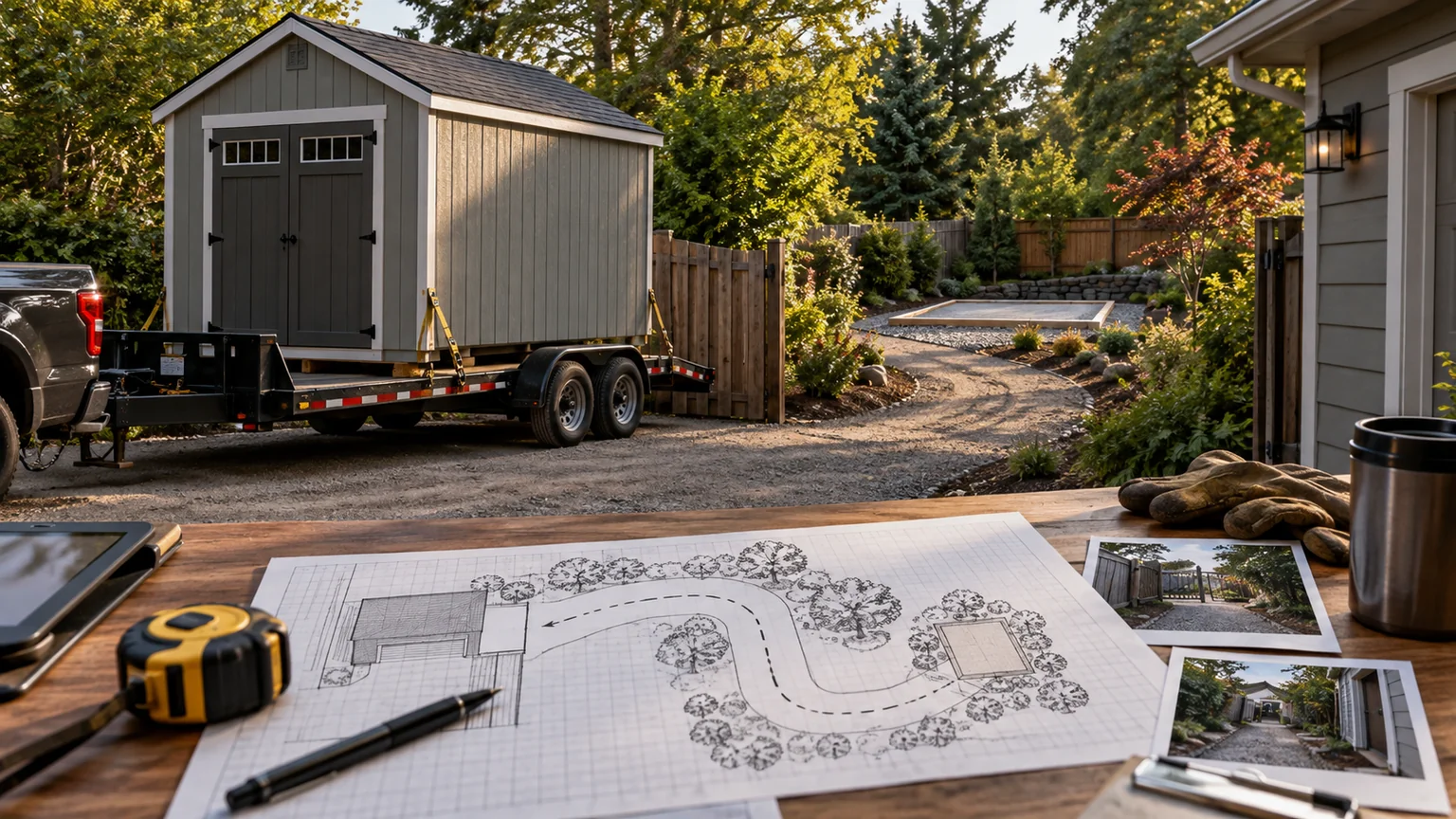
The gate is only one checkpoint. Start at the public approach and follow the path to the prepared site. Look for turning restrictions, trees, parked vehicles, narrow corners, changes in elevation, and obstacles that may not appear in a straight-on photograph.
Include the route the equipment will take after placement. Being able to enter a yard does not establish that the delivery vehicle can maneuver, place the building, and leave.
Ground conditions deserve their own conversation. A route that appears suitable in dry weather can behave differently after rain. Ask about drainage, soft ground, underground structures, and anything that must not carry equipment loads. Have the delivery operator decide whether the conditions are acceptable.
Use a short survey with clear ownership
A useful form does not need to be elaborate. It needs to make missing information visible and assign someone to resolve it.
| Check | Record | Confirmed by |
|---|---|---|
| Building | Order number, revision, transport dimensions, orientation | Production and delivery |
| Entrance | Narrowest opening and photographs | Surveyor and delivery |
| Route | Turns, slopes, overhead restrictions, temporary obstacles | Delivery |
| Ground | Surface, recent conditions, known underground constraints | Customer and delivery |
| Placement | Pad location, orientation, access, site readiness | Customer and delivery |
| Exceptions | Work required, responsible person, completion date | Assigned owner |
| Release | Go, hold, or alternative delivery method | Delivery coordinator |
Keep “unknown” as an available answer. It is safer and more useful than a checkbox someone marks merely to get the form submitted. An unresolved item should stop the release process when it affects the operator’s ability to complete the job.
Agree on changes before making them
Sometimes removing a fence section or selecting a different delivery method solves the problem. That decision needs permission, an owner, and a restoration plan. A neighbor’s willingness to help does not establish who owns the fence or who is responsible if it is damaged.
Write down what will be changed, who will perform the work, how the cost is handled, and what must be restored. If the route involves utilities, the relevant qualified people need to assess it. Do not improvise around overhead lines or treat an operator’s convenience as permission to alter a customer’s property.
When the available information is insufficient, rescheduling can be the responsible decision. Explain the reason plainly and give the customer a concrete path to clearing the hold.
Give the customer one confirmation to review
Before the truck leaves, send a concise placement summary: the approved building revision, orientation, arrival arrangements, prepared route, and any remaining customer tasks. A marked site photograph can be more useful than another paragraph of directions.
Ask the customer to identify anything that has changed since the survey. A new fence, a parked trailer, or recent ground work may invalidate an otherwise good plan. The review should be close enough to delivery to describe the actual site.
This is also the time to confirm who will be present and who can make decisions. Discovering that the person on site cannot approve a placement change is an avoidable source of delay.
Turn a difficult job into a better process
After a delivery problem, review the record before assigning blame. Was a dimension missing? Was the measurement convention unclear? Did the route change? Did information arrive but fail to reach the operator?
Choose a correction that addresses the cause. If the problem was an undefined measurement, add a diagram. If the problem was a handoff, change the release step. More checkboxes are only useful when someone knows what they mean and has the authority to act on the answer.
The gate example is memorable. The lasting improvement is less dramatic: a complete survey, an accountable review, and a delivery team able to say “ready” with evidence. Use the delivery checklist to organize that conversation, then read what a configurator should capture before the order reaches production.
Keep a good idea close.
Follow ForgeWorks